|
|
|
|
BepiColombo mission |
Japanese page>> |
|
|
|
|
|
|
BepiColombo mission |
|
|
|
|
|
The first spacecraft that got close to Mercury with 3 flybys is Mariner 10.
The trajectory of these flybys was proposed by the Italian scientist Giuseppe(Bepi) Colombo (1920-1984).
He is also known by the study of the mystery that the rotation period (58 days) and the revolution period around the sun (88 days) of Mercury is in the 2:3 resonance.
"BepiColombo" project, named after him by ESA, is the first large-sized Europe-Japan joint mission.
This mission consists of two orbiters and aims interdisciplinary and comprehensive studies of Mercury, including the magnetic field, the magnetosphere, the interior, and the surface.
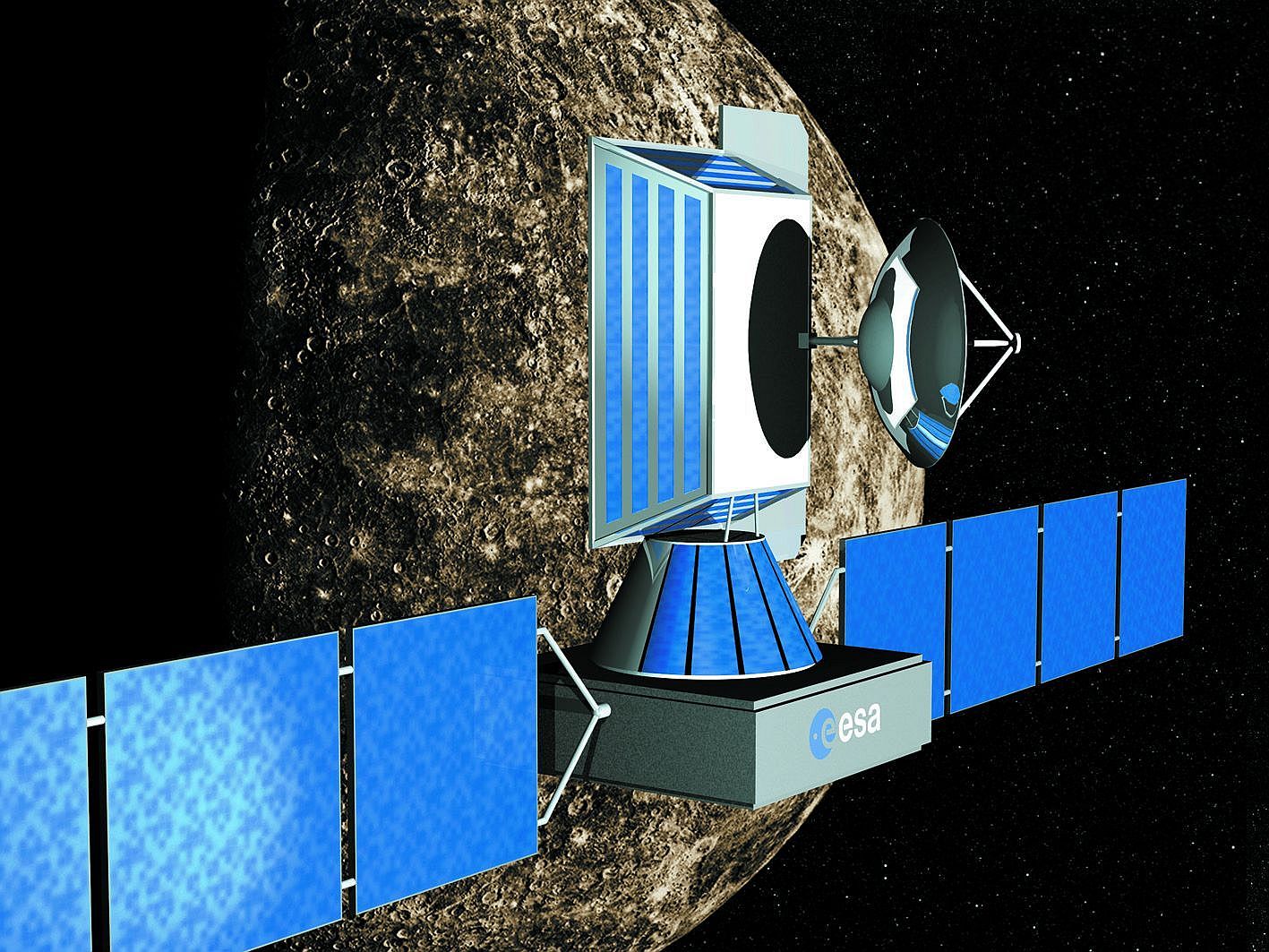
- Mercury Planetary Orbiter (MPO)
The 3-axis stabilized spacecraft provided by ESA.
Geology, composition, inner structure, and exosphere will be examined.
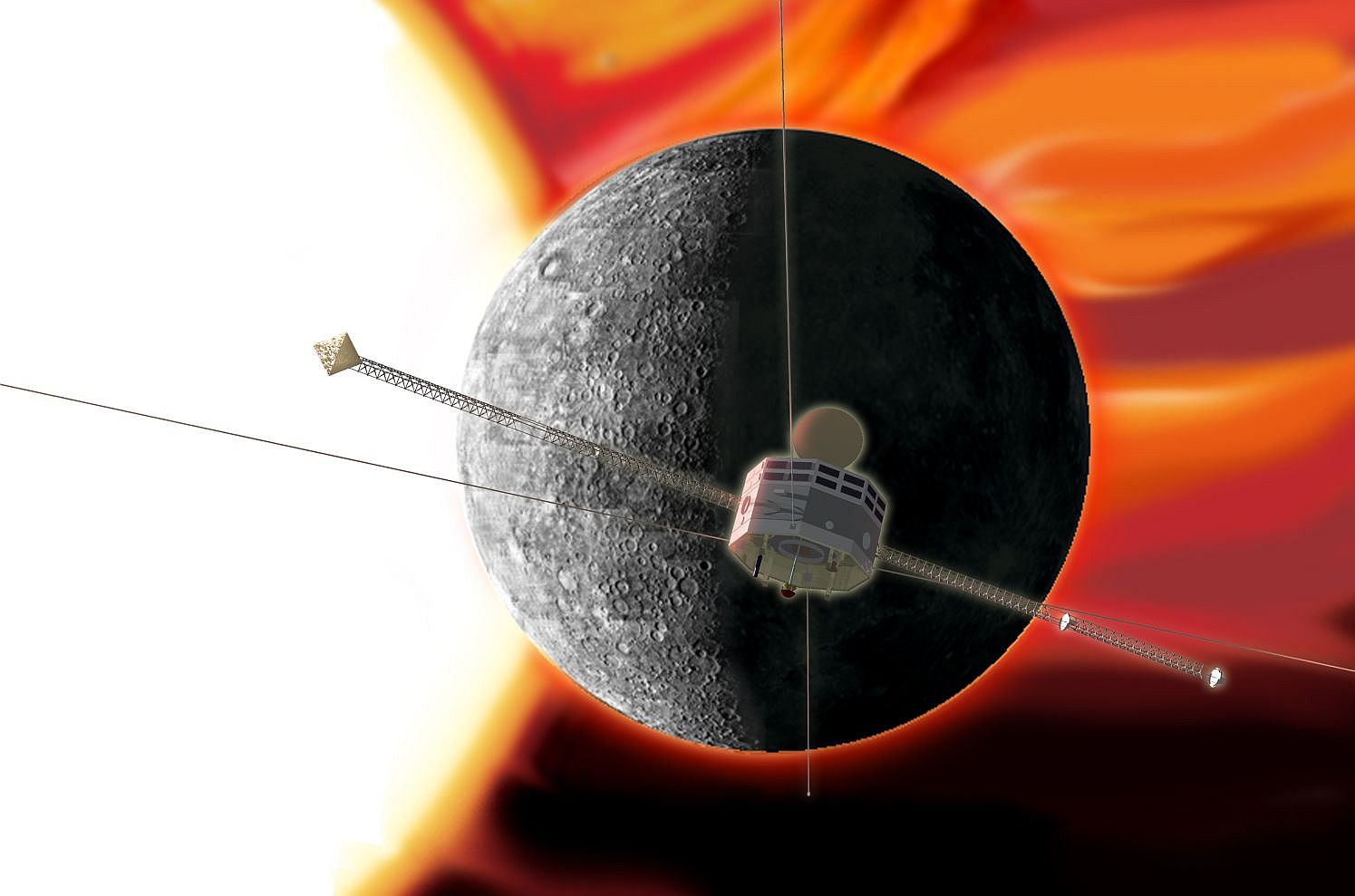
- Mercury Magnetospheric Orbiter (MMO)
The spin stabilized spacecraft provided by JAXA.
Magnetic field, atmosphere, magnetosphere, and inner interplanetary space will be studied.
|
|
|
|
|
|
Road to Mercury |
|
|
|
|
MMO and MPO will be combined with Solar Electric Propulsion Module (SEPM: provided from ESA), and Chemical Propulsion Module (CPM: provided from ESA).
The Unified module will be launched with Ariane 5 rocket, and travel together to Mercury.
Launch time aims August 2015, in the plan at October 2012.
In the interplanetary space, the unified module will be propelled by the SEPM which makes "small but steady/continuous" propulsion, associated with swingbys with the Moon, Venus, and Mercury.
Just before the insertion into the orbit around Mercury, SEPM will be separated.
After the separation of SEPM, the unified module will make a rapid slow-down by the CPM to come into the planned MMO orbit around Mercury.
We will separate MMO at this stage to begin independent operations, and the CPM will make the second propulsion for lowering the orbit of MPO.
Finally, MPO will be separated from the CPM.
Both spacecraft will make scientific observations for more than 1 earth year (4 Mercury years).
|
|
|
|
|
|
Mercury: Technical Challenge
|
|
|
|
|
In order to realize the Mercury orbiters,
we have to solve some technical difficulties.
Especially difficult things are:
- Mercury has greatly different revolution speed compared to Earth.
And its mass is small.
For those reason, the Mercury orbiter requires a high thrust.
- At Mercury, the sunlight is 11 times larger than at Earth in maximum.
Moreover, since the surface temperature of Mercury reaches a maximum of 700 K (Lead melts!), infrared radiation from the surface is also large.
For those reason, the anti-thermal techniques which do not have an example in the past space project are essential.
These problems are being conquered by technical development in recent years.
The former was solved by the electric propulsion system
(the asteroid probe HAYABUSA also used).
The latter is also solved by the "mirrors" on the spacecraft surface, etc.
There are several gateways for the travel to Mercury; the success of the launch, long cruising, several flybys with Moon, Venus, and Mercury, precise velocity controls, super-long distance communications, in the environment different from the one around the Earth.
Development of the spacecraft is now on going based on the experiences of the past missions including ISAS/JAXA
Geotail (Magnetospheric probe) /
Nozomi (Mars orbiter) /
HAYABUSA (Asteroid probe) and ESA
Cluster (Magnetospheric multi probes) /
Mars Express (Mars observer) /
Rosetta (Comet probe).
|
|
|
|
|
|
MESSENGER mission: Competition and Collaboration |
|
|
|
|
As other Mercury program, there is
MESSENGER
which have been adopted as one of the
Discovery programs of
NASA (USA).
MESSENGER was launched in 2004, and arrived at Mercury in March 2011 after the long journey of seven years.
The MESSENGER spacecraft is still in orbit around Mercury, sending a lot of scientific data that make us understand the Hermean environment.
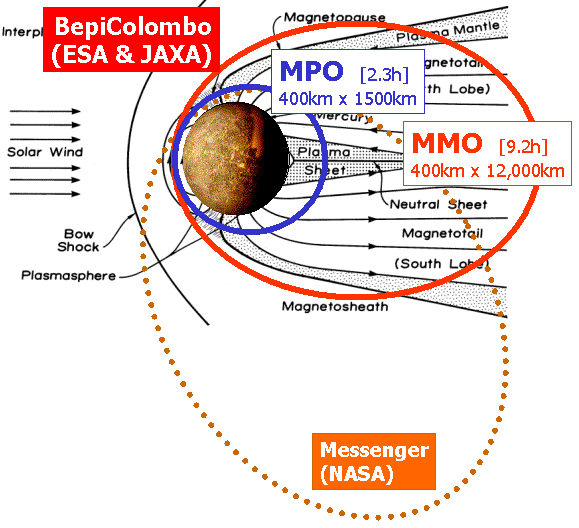
Because of the inclination of the orbit and the limitation of the field of view of the instruments, investigations for the whole magnetosphere or the internal structure of Mercury is difficult by MESSENGER.
However, it is making the first survey of the geology and composition on all surfaces of Mercury, and in particular observe Northern Hemisphere in detail.
Discovery by MESSENGER means the appearance of new observation targets for BepiColombo.
BepiColombo will complete the intensive study of Mercury begun with the exploration by MESSENGER.
Synergistic strategies of exploration will enable efficient use of BepiColombo resources in more detailed studies of Mercury.
|
|
|
|
|
|
|
BepiColombo mission: Spacecraft
|
|
|
|
|
|
Spacecraft
|
|
|
Development
Operation
|
European Space Agency (ESA)
- Development: ESTEC [European Space Research & Technology Center]
- Operation: ESOC [European Space Operation Center]
|
Institute of Space and Astronautical Science (ISAS)
Japan Space Exploration Agency (JAXA)
|
|
Objectives
|
Geology, Composition,
Interior, and Magnetic field
|
Magnetic field, Magnetosphere,
Atmosphere, Interplanetary Space
|
|
Mass(TBD)
|
Total: ~1140kg, Payload: ~80kg
|
Total: ~280kg, Payload: ~40kg
|
|
Science Teams
|
[Altimeter]
BELA (Laser Altimeter)
[Radio Science]
ISA (Accelerometer), MORE (Ka-band trans.)
[Magnetic field]
MERMAG (Magnetometer)
[Image & V-NIR Spectrum]
SIMBIO-SYS
[IR]
MERTIS-TIS
[Gamma and neutron]
MGNS
[X-ray]
MIXS (spectrometer), SIXS (Solar monitor)
[UV]
PHEBUS (spectrometer)
[Neutral / Ion particles]
SERENA
|
[MGF: Magnetic Field Investigation] (2 sub-teams)
studies magnetic field from the planet, magnetosphere, and
interplanetary solar wind.
[MPPE - Mercury Plasma Particle Experiment] (7 sub-teams)
studies plasma & neutral particles from the planet, magnetosphere,
and interplanetary solar wind.
[PWI - Plasma Wave Investigation] (7 sub-instruments)
studies electric field, electromagnetic waves, and radio waves from
magnetosphere and solar wind.
[MSASI - Sodium Atmosphere Spectral Imager]
studies thin sodium atmosphere of Mercury.
[MDM - Mercury Dust Monitor]
studies dust from the planet and interplanetary & interstellar space.
|
|
Orbit (TBD)
|
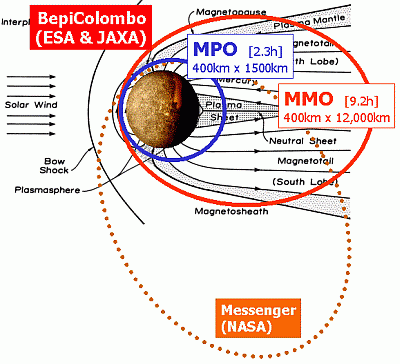
MPO: 400km× 1500km, Polar orbit
MMO: 400km×12000km, Polar orbit
|
|
|
|
|
|
|
|
|
|
|